CrimeCon is widely considered the world’s number one true crime event that connects experts in law enforcement, content creation, and advocacy to create a jam-packed weekend. Rather than sensationalize a serious topic “born out of someone’s misery,” CrimeCon focuses on psychology, victimology, and methodology.
I was lucky enough to attend CrimeCon UK 2023 in London, where I learned a wealth of knowledge and benefitted from inspirational and enlightening workshops.

While it was a tough job, I’ve narrowed my experience to the following five highlight sessions.
1. CrimeDoor
CrimeDoor discussed the use of future technologies, such as AR, VR, and AI, and their role in investigations and court proceedings today. By intersecting investigation and technology, these developments can be used to improve the efficiency and accuracy of justice processes.
2. Black Criminology Network
The BCN explored the perception of ethnic stereotypes and the aspects of true crime entertainment. Currently, the entertainment world stands the risk of the erasure of voices, and there are significant ethical considerations to keep in mind. The BCN also discussed the importance of positionality, which should be front of mind whenever telling another’s story.
3. Raphael Rowe - Second Chance
Raphael Rowe interviewed Colin Sutton, former Senior Investigating Officer in the Metropolitan Police, along the themes of his podcast, Second Chance. The pair discussed the value of getting the best out of people and how the importance of getting second chances out of incarcerated individuals impacts the community.
4. Former FBI Agent Katherine Scweit
Former FBI Special Agent Katherine Schweit is the author of Stop the Killing and How to Talk to Anyone About Guns. She presented a discussion on massing shootings in the United States, busting myths along the way. She also discussed the true problem of guns, America’s violent landscape, how to spot a shooter, and how to keep yourself safe.
5. Human trafficking and modern-day slavery
Author Louise Hulland, advocate Aisosa Henkoma, and human trafficking expert Phil Brewer joined forces to discuss the prevalence of human trafficking and modern-day slavery, with Aisosa sharing a powerful testimony of his own experience.
The goal of achieving justice is noble and admirable, but the meaning of justice differs around the world. For example, consider how legal processes differ from one country to another.
Features of legal systems
Whether you are a civilian, a legal professional, or a civil servant, it helps to understand the different features that establish legal systems — and limit the power.
- A national constitution (written or oral)
- Legislation, laws, and statutes that are prepared and authorized by a governing body
- Subordinate laws (bylaws) that are authorized by a network of bodies that hold powers granted by primary legislation
- Traditions, customs, and established behaviors practiced by the court to maintain a consistent legal environment
- A civil, common, or other code of laws that forms the primary source of principles and legal practices, such as a religious system
A combination of the above features has led to hundreds of unique systems of law used throughout the world. The overlap (and gap) of systems, rules, and policing has opened opportunities for transnational crime and empowered organized criminal organizations to find loopholes.
Point to ponder: what role does international law play in governing a global community, and how does it impact the different traditions, customs, and laws worldwide? Take note that sometimes, politicians play with statistics, and legal processes should be considered in a holistic view.

What is International law?
“International law is an independent system of law existing outside the legal orders of particular states.” - Brittanica
Rather than rely on a superior authority to enforce such rules, international law is considered a binding agreement among the states involved.
Who established international law?
The term international law was coined by English philosopher Jeremy Bentham who lived from 1748 to 1832.
What is described in international law?
International law has evolved over the years and covers various issues. For example, war, peace, diplomacy, human rights, economic and trade issues, space law, and even international organizations.
Although a legal order, international law strongly focuses on ethical principles and concerns, particularly human rights.
How is international law governed?
The United Nations General Assembly consists of representatives from 190 countries, operating as a forum that adopts multilateral treaties. While it appears as a legislature, the UN cannot issue binding laws. Instead, resolutions set forward by the UN only serve as a recommendation.
Different types of international law
There are different types of international law determined by the parties involved. Most commonly, there are treaties and international customs.
- Treaties, also known as conventions, agreements, pacts, general acts, charters, and covenants
- International customs
Good cop, bad cop is a negotiation strategy used in a variety of different industries, such as sales — and law enforcement.

What is the concept of good cop, bad cop
In the strategy, two individuals or parties work as a team to offer a series of rewards and punishments, hoping to get an advantage over another individual.
The bad cop presents a hostile and abusive attitude, which is countered by the good cop, who adopts a non-threatening and sympathetic approach, but is this an ethical approach for interrogation?

Is good cop, bad cop ethical?
While the principle doesn’t necessarily promote harm, it’s commonly extorted as a dirty negotiation tactic. Without proper control or protocol, acting as the bad cop can land the police officer in trouble, with the interrogation method appearing as extortion and even filing an incorrect police report.
Unfortunately, “good” cops have to pay the price of “bad” cops who adopt the negotiation strategy into their real-life persona.
learn more from bad people
Are you interested in more of this discussion?
Bad People have released a very interesting podcast episode on this exact topic, discussing whether the tactic actually works. Listen to the full episode here.
We argue that second chances are integral to the global community, playing a critical role in helping incarcerated individuals reform their behaviour and successfully reintegrate into society.
Second chances don’t only help with a smooth reentry but can also provide the opportunity to receive proper treatment for mental health disorders or assist individuals reaching potential through education (even if it is behind bars).
Second chances in the criminal justice system
In the criminal justice system, second chances are layered.
- The system needs to have mechanisms in place to offer offending individuals the chance to change their ways
- Incarcerated individuals need to give themselves a second chance
- Victims of crime offer forgiveness as a contribution to restorative justice
Second chances play an important part in restorative justice, where victims of crime release feelings of anger, resentment, and bitterness. It also helps to unblock the barriers of guilt.
Do these words echo true for you?
We argue that second chances are integral to the global community, playing a critical role in helping incarcerated individuals reform their behaviour and successfully reintegrate into society.
Second chances don’t only help with a smooth reentry but can also provide the opportunity to receive proper treatment for mental health disorders or assist individuals reaching potential through education (even if it is behind bars).
Seocond Chances in Restorative Justice
Research from Psychology Today reveals four powerful reasons to extend forgiveness to others and yourself.
- Forgiveness is important for subjective well-being as it offers emotional benefits, reducing anxiety, depression and major psychiatric disorders
- Personality isn’t set in stone, and second chances provide space for a person to change, grow, and learn from their mistakes
- Second chances are practical in conflict resolution and assist in preserving emotional energy
- Forgiveness is founded on the principle of treating others as you want to be treated
Point to ponder:
How have second chances played a positive role in your life? Now imagine the opportunity in a life-changing circumstance.
Formerly incarcerated individuals often refer to their release day as the best of their lives, but this joy can be short-lived during the adjustment period. Reentering society introduces various challenges such as finding employment, adjusting to a new routine, and dealing with overwhelming stress.
These difficulties often contribute to recidivism. In fact, a Nigerian review established that discrimination, lack of reintegration support, and the lack of employment lead to recidivism. The Bureau of Justice revealed similar statistics.

According to their study of 30 US states between 2005 and 2010, one-third of released individuals reoffended within six months.
However, effective intervention and support can change the narrative.
The doe Fund
The Doe Fund is an NYC-based nonprofit that strives to do exactly that by releasing male prisons through its Ready, Willing & Able program. Participants get paid to clean the streets and sidewalks of the city and continue to train for more specific trades. At the end of the program, participants are connected with job opportunities that help them get back on their feet.
An independent study by Harvard University's Dr. Bruce Western concluded that the program cuts the risk of future police contact by one-third.

One of these men is William Bossio, who struggled to reintegrate into society after his release. William did several prison stints after failing to keep up with the bills and the pressure to return to a life of crime. His parole officer introduced him to the program and pushed him to make the right decision.
Through the program, William has found hope after prison and feels “blessed to find a job.”
Read the full story at Business Insider.
One of the biggest challenges that formerly incarcerated people face is finding employment. Not only do many employers refuse to hire people with a criminal record, but people often leave prison without the education and basic skills needed to maintain employment.
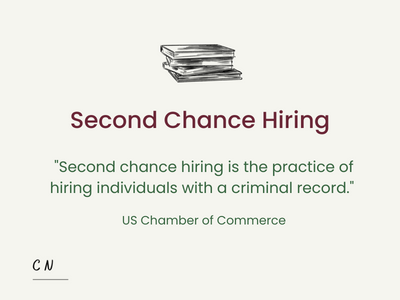
That’s where businesses like Nehemiah Manufacturing come in, offering formerly incarcerated individuals a chance at reentry without judgment. Their story has been shared by Stand Together.
Nehemiah Manufacturing
At Nehemiah Manufacturing, 80% of employees are second chances hires, providing a place for formerly incarcerated people to earn a living and contribute to the economy while being treated with dignity and respect for who they are today and not what they did in the past.
Second chance hiring also plays a role in meeting worker shortages. In the instance of the manufacturing industry, the United States is expected to have 2.1 million manufacturing jobs unfilled by 2030, contributing to a $1 trillion loss in gross domestic product.
The Manufacturing Institute is countering this problem by creating programs for second chance hiring, and businesses have responded by embracing the opportunity to recruit and retain second chance hires.
The Value of Second-Chance Hiring
Businesses and communities are being strengthened through these programs. For example, turnover rates are lower among second-chance hires, helping businesses save money on hiring and training.
The vast majority of HR professionals (85%) and business leaders (81%) also report that second-chance hires perform the same or even better than employees without a criminal record.

As the workplace culture shifts to be more inclusive, second chance hiring is proving valuable for both individuals and businesses, strengthening the economy and stabilising communities.
What would you do if you spent 25 years incarcerated for a crime that you didn’t commit?

While many would be angry and vengeful, Patrick Pursley has chosen to always work for love, which he believes to be the highest vibration of the human spirit.
Patrick Pursley was wrongfully convicted of a 1993 murder. Despite no blood, fingerprint, or DNA evidence to tie Patrick to the crime, political pressure and inconsistent testimonies from a ballistic expert found him convicted.
Despite these tragic circumstances, Patrick has focused on reinventing his story and helping others overcome their vulnerable position.
I Am Kid Culture Movement
Not only did Patrick dedicate time and effort to becoming a jailhouse lawyer, but since his release, he has also started the I am Kid Culture movement which is committed to creating solutions to gun violence. Its mission is to reach at-risk youth to encourage them to set goals, pave career paths and have access to guidance through arts and curriculum.
Causes for at-risk youth in the United States
- Growing up in an area with heavy gang activity
- History of violence in the home
- Too little adult supervision
- Unstructured free time
- Lack of positive role models
- Sense of hopelessness due to limited opportunities
- Underlying mental health issues or behavioural disorders
By reducing the gang and gun violence, Patrick Pursley has tapped into the good of human nature to empower youth.
Let’s zoom in on the United States for a moment.

reform and justice
According to Public Agenda, America’s Hidden Common Ground on Police Reform and Racism in the United States,
“Nearly all Americans across the political spectrum and across racial/ethnic groups support officers wearing and using body cameras (94% of Republicans, 91% of Democrats, and 86% of Independents; 92% of white Americans, 87% of Black Americans, 88% of Hispanic Americans).”


The driving force behind these statistics is a desire to know the truth about what really happens during these exchanges.
Without evidence of how authority is exercised, people are left to narrate their own version of the story, often contributing to stigma and cycles of hate in the process.

The Marshall Project produces non-profit journalism that is committed to demystifying the American criminal justice system. We’ll be sharing more about this incredible organisation in posts to come…
supporting independent journalism
Call to donate to The Marshall Project!
At Chosen Narrative, we believe in the powerful potential that journalism can have on educating the public and driving reform in the criminal justice system.
We respect the Marshall Project’s fair, transparent and humane approach to journalism and their obvious commitment to reform. That’s why we contribute a small amount each month to help The Marshall Project tell stories that matter.
We encourage you to donate to the nonprofit journalism which “establishes facts, exposes failures and examines solutions for a criminal justice system in crisis”.
They warn us not to believe everything that we read on the internet, and the sentiment holds true for what is shared in the media.

You may have heard stories about the War on Drugs, led by President Nixon. The period started in the 1970s and drew a definitive line between different racial groups in the United States.
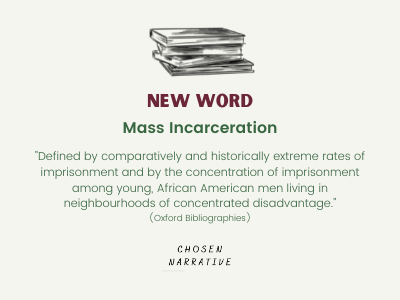
Esteemed author, Michelle Alexander, pinpoints this period as a pivotal moment in the history of mass incarceration.
In her book, “The New Jim Crow: Mass Incarceration in the Age of Colour-blindness” she notes that the rate of drug crime was actually *declining* instead of rising when the war was declared.
A stellar book on social justice
She compares the statistics and notes how the US incarceration rate quadrupled between 1960 and 1990. This figure was compared to countries with a similar incarceration in 1960. For example, Germany’s incarceration rate remained the same while Finland’s incarceration rate fell by 60%.

Michelle Alexander writes, “The stark and sobering reality is that, for largely unrelated to actual crime trends, the American penal system has emerged as a system of social control unparalleled in world history.”
The media played a significant role in driving the War on Drugs, using sensational headlines and single-sided narratives to inspire fear and panic.
Ultimately, it’s important to consume information conscientiously and with an open mind.
On UNESCO's World Book Day, 23 April 2022, we celebrated the power of knowledge and the written word with a recommendation.

The New Jim Crow: Mass Incarceration in the Age of Colourblindness was written by Michelle Alexander and has been described as “The Bible of a social movement” by the San Francisco Chronicle.
The book studies the history of the United States and how racial segregation has evolved to placate those who aren’t paying attention.
Michelle opens her book with the following words, “This book is not for everyone. I have a specific audience in mind - people who care deeply about racial justice but who, for any number of reasons, do not yet appreciate the magnitude of the crisis faced by communities of colour as a result of mass incarceration.”
Add Michelle Alexander's thought-provoking book to your reading list and pick up a copy wherever you buy your books!
At Chosen Narrative, we aspire to share the individual stories behind statistics. But what happens when these statistics are skewed?
A study by the marshall project
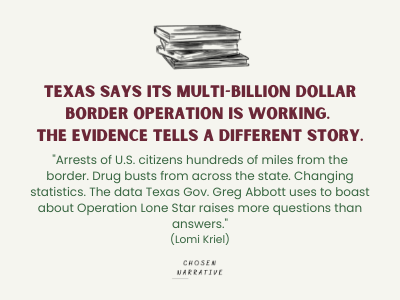
It’s not unusual for politicians to use statistics to their advantage, even if the presentation of the numbers needs to be tweaked slightly. The Marshall Project recently published a fascinating article that demonstrates how political leaders amplify certain figures and shift metrics in order to further their campaign.
The article covers Operation Lone Star and describes how Texas Governor Greg Abbott skewed data to suggest that a multi-billion dollar border operation was working. His main goal? To get re-elected.
Gary Hale, a former Chief of Intelligence for the Drug Enforcement Administration said, “The whole reason for all this, you know, playing with statistics, is for optics so that the governor could get re-elected. We really haven’t had any significant impact on migrant smuggling or drug trafficking.”
Is our trust in statistics misplaced?
Where does that leave us as the general public? Is our trust in statistics misplaced?
Alone, statistics only scratch the surface. Listening and learning will take us deeper toward better understanding.
Read the full story on The Marshall Project here.