Discuss existing and potential governmental responses to right-wing nationalism and neo-Nazism in one or several countries. Are these punitive and preventive measures sufficient in addressing those ideologies?

The severity of the threat of right-wing terrorism has been debated in recent years, with many arguing that right-wing terrorism is rising, particularly compared to Islamic religious terrorism. Other analysts argue that the threat is overstated (Jones et al., 2020).
However, right-wing terrorism’s connection to right-wing nationalism and neo-Nazism, and the associated threat of violence, xenophobia, and political turbulence, presents a security threat to the United States and the rest of the world (Koehler, 2015).
It is essential that national governments introduce both punitive and preventive policies to address rising ideologies of hatred and violence.
I will briefly discuss the rise of right-wing nationalism and neo-Nazism in Europe (using the Pan-Nordic region as an example) and the United States of America. Next, I will compare existing governmental responses and assess the effectiveness of these measures. Finally, I will recommend additional policy efforts to consider.
Presence of right-wing nationalism and neo-Nazism
The resurgence of right-wing nationalism, a political ideology that combines right-wing politics and populist rhetoric and themes, desires to bring back power to the people and is typically antithetical to liberal democracy (Halikiopoulou, 2019).
Right-wing nationalism is typically hegemonic in its cause as a collective (Halikiopoulou, 2019), and extreme right-wing nationalism and activism are connected with neo-Nazi subcultures that exercise violence and racism (Mattsson & Johansson, 2021).
Some of these right-wing extremist groups are based within a certain region, while others are transactional in nature (and threat). By comparing extreme right-wing nationalism between Pan-Nordic countries and the United States, I hope to draw on similarities and differences between the threat.
Right-wing nationalism in Pan-Nordic countries
Much of the focus on right-wing nationalism is centered on Europe, home to several established right-wing terrorist networks. For example, Nordiska motståndsrörelsen (Nordic Resistance Movement, or NRM) is a transnational neo-Nazi organization that operates in Sweden, Denmark, Norway, and Finland. The NRM has threatened and attacked minority groups such as homosexual communities, Muslim asylum seekers, and ideological rivals (Jones et al., 2020).
Consider Denmark in the 1980s. The country experienced increased immigration which led to the emergence of a xenophobic subculture and the strong presence of the radical right. Various political and social movements have evolved the radical right into a social movement that includes nationalist associations, militant skinheads, and neo-Nazis.
While there have been lulls in popularity as rival ideologies counter the efforts of the extreme right, national and international circumstances in the past two decades have offered new opportunities for the Danish radical right — both in the streets and as a parliamentary voice (Karpantschof & Mikkelsen, 2017). Similar trends and developments have emerged in other Pan-Nordic countries.
Right-wing nationalism in the United States of America
In the United States, the Anti-Defamation League’s Center on Extremism has assembled a list of 150 right-wing terrorist acts and attempts between 1993 to 2017 (ADL report, 2022).
Unlike European examples, where right-wing nationalists are often members of organized and/or political groups, many of these attacks in the United States are seemingly executed by lone perpetrators connected to (or inspired by) an underground network with leaderless resistance (Frontline PBS, 2020). Most right-wing extremist attacks fall under two categories: white supremacists (including neo-Nazis) and anti-government extremists (ADL report, 2022).
In recent years, organized groups branded right-wing nationalists in the United States, such as the Proud Boys and the Oath Keepers, have become more prominent. As in the Pan-Nordic region, certain international and social developments have created a platform for right-wing nationalists to gain momentum. For example, the strengthening of liberal political parties and their ideologies (Pahnke, 2021) and the military response to white-power activism (Frontline PBS, 2020).
Existing governmental responses and effectiveness
Political and social expression is fundamental in right-wing nationalism and extremist movements, and governmental policies are necessary to prevent and punish threats and acts of violence.
Governmental responses in Pan-Nordic countries
The NMR is pro-violence and uncompromising, spreading its political agenda and leveraging different kinds of violence, threats, and harassment to prevent retaliation. Yet the NMR remains a legal organization (in Sweden), and NMR members swiftly confront politicians who criticize the movement (Kenes, 2021).
NMR leadership dismisses illegal activities committed by members as isolated and independent acts. In response, the government has mapped out the most active members in the NMR. A minority percentage have been convicted or prosecuted for crimes, with almost a quarter of cases leading to imprisonment. The NMR is also on the radar of the Swedish Security Police (Säpo), who have classified the NMR’s violent tendencies as the second biggest threat in Sweden (after Islamic terrorism) (Kenes, 2021).
Apart from monitoring groups and punishing violent perpetrators, the government is also implementing policies that prioritize equality and promote equal treatment of all persons without discrimination based on gender, race, or ethnic origin. For example, Denmark has established the Danish Institute for Human Rights (DIHR). In addition, the court has found discriminatory video statements by the leader of the Hard Line extreme-right party not to be protected by freedom of speech (ECRI, 2022).
Some European countries have banned right-wing extremist networks and placed sanctions on right-wing extremist groups that allow governments to freeze financial assets and criminalize group members. However, the internet and social media forums remain important platforms for right-wing extremists to spread propaganda and coordinate their actions (Jones et al., 2020).
Other efforts to strengthen democracy against extreme right-wing nationalism in Sweden include initiatives to increase election turnout to enhance democratic awareness, implement democracy-promoting initiatives in civil society, promote democracy in schools, and protect human rights by combatting discrimination, xenophobia, and other forms of intolerance. Culture is prioritized as part of the democratic system, and there are initiatives to reduce exclusion among young people and foreign-born individuals (Björklund & Ohlsson, 2011).
Governmental responses in the United States of America
In the United States of America, the comparable right-wing movement is composed of a “highly diverse and loosely connected network of individuals and groups who reject U.S. laws, taxation, currency, and the government’s legitimacy, especially regarding the control of firearms.” (Koehler, 2015).
The fluid and underground nature of these groups makes it difficult for law enforcement to detect communication and group structures before a violent event occurs. Even so, the United States has not banned any far-right organizations (Jones et al., 2020), and the focus remains on religious terrorist networks such as the Islamic State and al-Qaeda.
Although not always apparent, the early warning signs of violent right-wing actions are often ignored, as was the case with the January 06 storming of the Capitol Building, which revealed the lack of preparation for the event and the failure to translate operational intelligence into an effective preventative plan (Perliger, 2023).
Policy recommendations focus on better communication and coordination between the federal government, law enforcement, and intelligence agencies to prevent future events of a similar nature. Public education and awareness of the threat of domestic terrorism is also a priority (Perliger, 2023).
As punishment, civil lawsuits for damages by the victims of far-right violence have been an effective tool (Perliger, 2023). The Biden Administration has also introduced a new unit within the Justice Department that consists of a team of attorneys dedicated to investigating domestic terrorism and tightening the focus on U.S. national security within the borders (Bergengruen & Hennigan, 2022).
Effectiveness of governmental responses
While these preventive and punitive measures acknowledge the threat of extreme right-wing nationalism and neo-Nazi movements, the threat remains understated and debated.
Both the loose and fluid nature of these networks in the United States of America (as well as the country’s strong policy on free speech) and the political authority of these organizations in Pan-Nordic countries suggest that greater effort is needed to focus on preventing the threat of violence.
By studying the United States and the Pan-Nordic region as two Western regions with differing politics and cultures, it is apparent that nuanced efforts are needed to address the cause of right-wing nationalism and the triggers that inspire growth in each region. Some of these efforts will overlap, while others are more specific to the political and social climate.
Potential governmental responses
Mattsson and Johansson (2020) report on the role school and teachers play in handling racism in schools to prevent the growth of the neo-Nazi movement in Sweden. Results show that attempts to isolate troubled students lead to resistance and stigmatization, which fuel the radicalization process. To prevent this from happening, schools and their staff should be educated on the difference between promoting an anti-racist agenda and satisfying the cognitive and emotional needs of racist students.
A long-term approach is recommended by Perliger, who suggests the development of socialization and behavioral processes can prevent political polarization in the United States (2023). A push for developing mechanisms and solutions that address the spreading of hate speech, misinformation, and extremist rhetoric in online spheres should also be a key focus (Perliger, 2023).
In both regions, public education on immigration and its implications are crucial for improving tolerance for migrant communities. Reeskens & van Oorschot suggest that public opinion toward migrants originates from “aspirations about citizenship, as well as perceptions about its realization” (2017). Policymakers should be concerned about the impact of misinformation and how it correlates with immigration policies to nurture a public opinion of tolerance.
Finally, the origins of violence should be considered and intercepted. Mattsson and Johansson study how violence is reproduced and how a violent upbringing and a violent environment during childhood create ideal conditions for a violent neo-Nazi lifestyle (2021). Effective prevention strategies are essential to promote awareness about child mistreatment and to foster a commitment to social change, especially for at-risk children in schools.
References
- ADL Report. (2022). A Dark and Constant Rage: 25 Years of Right-Wing Terrorism in the United States. Accessed on May 20, 2023, from https://www.adl.org/sites/default/files/CR_5154_25YRS%20RightWing%20Terrorism_V5.pdf
- Bergengruen, V. & Hennigan, W. (January 24, 2022). Prosecuting Domestic Terrorism is Notoriously Difficult. This New Team of Lawyers Has a Mounting Caseload. TIME. Accessed on May 20, 2023, from https://time.com/6140308/domestic-terrorism-justice-department-unit-joe-biden/
- Björklund, J. & Ohlsson, B. (2011). Action plan to safeguard democracy against violence-promoting extremism. Government Offices of Sweden. Accessed on May 20, 2023, from https://www.government.se/contentassets/b94f163a3c5941aebaeb78174ea27a29/action-plan-to-safeguard-democracy-against-violence-promoting-extremism-sr.-20111244 ECRI. (2022).
- ECRI Report on Denmark (sixth monitoring cycle). Council of Europe. Accessed on May 20, 2023, from https://rm.coe.int/6th-ecri-report-on-denmark-/1680a6d5e4
- Frontline PBS | Official. (November 03, 2020). Documenting Hate: New American Nazis (full documentary) | Frontline. [Video]. YouTube https://youtu.be/-XFBVAAzXjc
- Halikiopoulou, D. (2019) Right-wing populism as a nationalist vision of legitimating collective choice: a supply-side perspective. The International Spectator, 54 (2). pp. 35-49. ISSN 0393-2729 doi: https://doi.org/10.1080/03932729.2019.1588544
- Jones, S., G., Doxsee, C., and Harrington, N. (March 2020). The right-wing terrorism threat in Europe. A report of the CSIS Transnational Threats Project. Center for Strategies and International Studies.
- Karpantschof, R., & Mikkelsen. F. (2017). The rise and transformation of the radical right movement in Denmark 1980–2015. Studies in Conflict & Terrorism 40, 8, 712-730.
- Kenes, B. (April 2020). NMR: A Nordic neo-Nazi organization with aims of establishing totalitarian rule across Scandinavia. ECPS. Accessed on May 20, 2023, from https://www.populismstudies.org/wp-content/uploads/2021/05/ECPS-Organisational-Profile-Series-4.pdf
- Koehler, D. (2015). Right-wing extremism and terrorism in Europe. Current developments and issues for the future. Prism 6, 2, 85-104.
- Mattsson, Ch. & Johansson, Th. (2020) The hateful other neo-Nazis in school and teachers strategies for handling racism, British Journal of Sociology of Education 41, 8,1149-1163,
- Mattsson, Ch., & Johansson, Th. (2021). “We are the White Aryan Warriors”: Violence, homosociality, the construction of masculinity in the National Socialist Movement in Sweden. Men and Masculinities 24, 3, 393-410.
- Pahnke, A. (March 31, 2021). How the far right got a stranglehold on the West. Aljazeera. Accessed on May 20, 2023, from https://www.aljazeera.com/features/2021/3/31/how-the-far-right-got-a-stranglehold-on-the-west
- Perliger, A. (January 02, 2023). Contextualizing the Jan 6th Report: Contemporary Trends in Far-Right Violence in the US. ICCT. Accessed on May 20, 2023, from https://www.icct.nl/publication/contextualising-jan-6th-report-contemporary-trends-far-right-violence-us
- Reeskens, T., & Van Oorschot, W. (2017). Conceptions of Citizenship and Tolerance towards Immigrants. In Oxford University Press eBooks (pp. 177–198). https://doi.org/10.1093/acprof:oso/9780198795452.003.0007
While each country has different legal frameworks, Article 7 of the Universal Declaration of Human Rights (UDHR) states "All are equal before the law and are entitled without any discrimination to equal protection of the law."
Unfortunately, this basic principle of liberalism exists more in theory than in practice.

Recently, a digital side event to the 31st Session of the UN Commission on Crime Prevention and Criminal Justice was hosted on the topic of decisive action to reform laws that criminalise poverty and status. The panel was joined by criminal justice leaders from around the world, including South Africa, Brazil, the West Indies and more.
UN Commison on Crime Prevention & Criminal justice
Various issues were raised, including the serious issue of putting people behind bars not because of their actions, but because of who they are. In the opening remarks, Rachel Rossi describes the shared goal of equal justice under law for all. The law, if applied fairly and wisely, can serve as an instrument of justice. But for the poor, it can lead to a series of profound problems.
Representing the US Justice Departments Office for Access to Justice (ATJ), Rachel Rossi outlined the newly-released equity plan that intends to increase access to justice in five key areas, removing environmental barriers that limit access to justice.
ATJ efforts include reforms against acts of hate. Consider that Anti-Asian hate crimes have increased by nearly 150% in 2020 and that the FBI reports that hate crime is the highest that it has been in more than a decade.

Justice is layered and complicated, manifesting differently for groups of people. Rachel concluded her presentation with the words of Bryan Stevenson, social justice activist who said, “the opposite of poverty isn’t wealth but instead it is justice.”
Vagrancy Laws and criminalising poverty
Offences, such as breaking vagrancy laws, are criminalised, despite not being criminal in nature. These laws impact hawkers and informal traders, a solution for many people who can’t find employment.
Yet as Judge Makume says, “These laws are inconsistent with the right to dignity.”
Judge Makume is the Chairperson of Legal Aid South Africa, an organisation which strives to represent marginalised people in South Africa —- and they have their hands full.
According to the World Bank report, South Africa is the most unequal country in the world. Judge Makume joined the discussion for the 31st Session of the UN Commission on Crime Prevention and Criminal Justice, shedding light on how poverty in South Africa is largely impacted by strong racial, gender, age and spatial dimensions.

Many cities in South Africa have criminalised the marginalised and poor through poverty laws, with a lot of these marginalised communities being formed by immigrants from neighboring countries.
Vagrancy laws are often vague and overly broad, leading to arbitrary and discriminatory action. Ultimately, enforcement of vagrancy laws are done on the basis of economic status — and so the cycle of poverty continues.
Criminalisation by Status
The criminalisation of poverty is a striking example of criminalisation by status.
The United Nations Human Rights standards have been emphasising that the criminalisation of poverty is unacceptable, but as a community, we need to believe it to be true in order to lobby for change. So, why should we address the criminalisation of poverty and status?
Olivier De Schutter, UN Special Rapporteur on extreme poverty and human rights, attended the discussion for the 31st Session of the UN Commission on Crime Prevention and Criminal Justice. He suggests the following suggestions on why we should address the criminalisation of poverty by status.
- It feeds stereotypes about people in poverty. They are described as having chosen their position and seen as a threat to society and this is the symbolic message that the law sends.
- All too often, criminalising life-sustaining activities is a pretext for not addressing the structural causes of poverty.
- It propels the vicious cycle between poverty and criminalisation. Poverty leads people to be criminalised because they can not afford to pay fines or taxes, and they can’t live decently. As a result, they are further marginalised and pushed into poverty.
Assessing your current assumptions is the first step toward change.

Vagrancy laws are a set of rules that make it a crime for a person to wander from one place to another with no visible means of support. In most instances, vagrancy laws criminalise the homeless and jobless.
Petty Offences is committed to decriminalising and reclassifying petty offences in Africa which shackle those who are already oppressed by the system and community.
Count the cost of exclusion: decriminalising poverty and status
The organisation recently hosted a seminar titled “Counting the cost of exclusion: decriminalising poverty and status”.
Dr. Tarryn Bannister, APCOF, explained how vagrancy laws punish, segregate and control people based on who they are rather than what they’ve done.
These people are normally vulnerable already and live with a lack of education and homelessness. They are usually unable to pay for fines which further exacerbates their financial vulnerability.
In many ways, vagrancy laws can be likened to the chicken or the egg analogy, with no clear solution or progress.
Take a moment to consider the prejudice that you hold against different groups of people.

Assumptions and poverty
Tunisian lawyer and activist, Sana Ben Achour, shared her thoughts and studies on the matter during the recent seminar hosted by Petty Offences on “Counting the cost of exclusion: decriminalising poverty and status”.
While discussing the repercussions of vagrancy laws, Sana drew attention to the assumptions that large parts of society hold against poverty, including;
- Theft
- Damage to property
- Criminal (or the potential to be)
- Delinquent behaviour
theft, damage to property etc. In many ways, being poor means that you are (or hold potential to be) a criminal or delinquent.
These presumptions around criminality and stereotypes prevent progress and generate a harmful attitude toward the vulnerable and marginalised.
As conscious citizens of the world, we should constantly be questioning the assumptions that we make and whether or not they are valid and/or helpful.


coming back to statistics...
... or the lack thereof.
In the recent seminar by Petty Offences, Sexual Orientation and Gender Identity Advisor for the World Bank Group, Clifton Cortez, introduced a powerful thought.
On the topic of vagrancy laws, Clifton suggests that legal analysis should be followed by economic analysis. Often, legal framework serves as a barrier to economic growth, which keeps the marginalised in the folds of society.

As an example, nearly every country has laws to harass sexual minorities to some degree, especially those who are poor. Even though direct criminalisation of sexual minorities has been falling in developed countries, harrassment continues elsewhere. In some places, there is even the increased threat of harassment.
European Parliament reports that “Three out of five African countries have laws criminalising homosexuality and the public expression of sexual or gender behaviour that does not conform with heterosexual norms.”

Data is key to understanding the obstacles that sexual minorities face, yet their stories are seldom documented. In addition, their struggles are often credited to other issues that are less controversial.
While data is important to understanding a situation, it’s equally important to present a holistic picture and gather information on the social and economic impact of legal framework.
At Chosen Narrative, we aspire to share the individual stories behind statistics. But what happens when these statistics are skewed?
A study by the marshall project
It’s not unusual for politicians to use statistics to their advantage, even if the presentation of the numbers needs to be tweaked slightly. The Marshall Project recently published a fascinating article that demonstrates how political leaders amplify certain figures and shift metrics in order to further their campaign.
The article covers Operation Lone Star and describes how Texas Governor Greg Abbott skewed data to suggest that a multi-billion dollar border operation was working. His main goal? To get re-elected.
Gary Hale, a former Chief of Intelligence for the Drug Enforcement Administration said, “The whole reason for all this, you know, playing with statistics, is for optics so that the governor could get re-elected. We really haven’t had any significant impact on migrant smuggling or drug trafficking.”
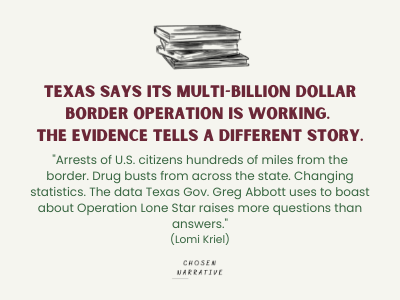
Is our trust in statistics misplaced?
Where does that leave us as the general public? Is our trust in statistics misplaced?
Alone, statistics only scratch the surface. Listening and learning will take us deeper toward better understanding.
Read the full story on The Marshall Project here.