Let’s zoom in on the United States for a moment.

reform and justice
According to Public Agenda, America’s Hidden Common Ground on Police Reform and Racism in the United States,
“Nearly all Americans across the political spectrum and across racial/ethnic groups support officers wearing and using body cameras (94% of Republicans, 91% of Democrats, and 86% of Independents; 92% of white Americans, 87% of Black Americans, 88% of Hispanic Americans).”


The driving force behind these statistics is a desire to know the truth about what really happens during these exchanges.
Without evidence of how authority is exercised, people are left to narrate their own version of the story, often contributing to stigma and cycles of hate in the process.

The Marshall Project produces non-profit journalism that is committed to demystifying the American criminal justice system. We’ll be sharing more about this incredible organisation in posts to come…
supporting independent journalism
Call to donate to The Marshall Project!
At Chosen Narrative, we believe in the powerful potential that journalism can have on educating the public and driving reform in the criminal justice system.
We respect the Marshall Project’s fair, transparent and humane approach to journalism and their obvious commitment to reform. That’s why we contribute a small amount each month to help The Marshall Project tell stories that matter.
We encourage you to donate to the nonprofit journalism which “establishes facts, exposes failures and examines solutions for a criminal justice system in crisis”.
At Chosen Narrative, we aspire to share the individual stories behind statistics. But what happens when these statistics are skewed?
A study by the marshall project
It’s not unusual for politicians to use statistics to their advantage, even if the presentation of the numbers needs to be tweaked slightly. The Marshall Project recently published a fascinating article that demonstrates how political leaders amplify certain figures and shift metrics in order to further their campaign.
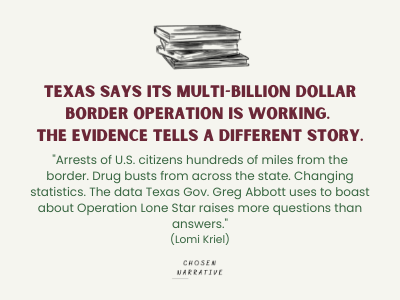
The article covers Operation Lone Star and describes how Texas Governor Greg Abbott skewed data to suggest that a multi-billion dollar border operation was working. His main goal? To get re-elected.
Gary Hale, a former Chief of Intelligence for the Drug Enforcement Administration said, “The whole reason for all this, you know, playing with statistics, is for optics so that the governor could get re-elected. We really haven’t had any significant impact on migrant smuggling or drug trafficking.”
Is our trust in statistics misplaced?
Where does that leave us as the general public? Is our trust in statistics misplaced?
Alone, statistics only scratch the surface. Listening and learning will take us deeper toward better understanding.
Read the full story on The Marshall Project here.
At Chosen Narrative, we're committed to using language and storytelling to educate, induce empathy and inspire change.

Advocates have argued that choice of language can have stigmatizing effects that can negatively impact a person's ability to participate in social life and prevent them from reaching their full personhood. The World Health Organization recommends that language should not discriminate against stereotype or demean people based on age, ethnicity, gender, sex or sexual orientation and physical or intellectual impairments.
However, it doesn't specifically address the impact that stigmatizing language has on people involved in the criminal justice system. We hope to use language to empower people in the criminal justice system - and beyond.
There are certain words that were regularly used throughout history but have since been removed from everyday vocabulary, and for very good reason. In fact, using some of these discriminatory terms can trigger violent responses, inspire hatred and solidify stereotypes.
Words used in the system
How much thought do you give when referring to an incarcerated individual? Do you consider how the act of branding a person will impact their identity as well as their ability to overcome existing challenges?
Consider the words typically used for people in jail and/or prison:
- Inmate
- Prisoners
- Convicts
- Felon
- Offender
These words are more weighted than they seem.


A little bit of independent thought can challenge social conditioning. A recent series published by The Marshall Project sheds light on the power of language, and why it matters when talking about the criminal justice system - and those involved.
The death of George Floyd kickstarted a new wave of social justice, activism and increased awareness of criminal justice. Since then, various individuals and groups have used the momentum to push for policy change and raise awareness on concerning issues with existing systemic “justice”.
What many don’t realize is that the current movement is another milestone in a very long journey striving toward social justice.
Language of incarceration
Senior lecturer at University of Essex , Alexandra Cox, explores the language of incarceration, saying, “Radical prison activists in the 1960s and 1970s used the official language of the prison state to challenge its power."
She notes that leaders also strived for reform, with President Obama writing an article in the Harvard Law Review about criminal justice reform strategies, invoking language such as “formerly incarcerated individuals”.


Read more about Alexandra’s think piece of using “people first” language in the context of incarceration for context on a historical and contemporary perspective.
