What is the role of media and schools in propagating and/or preventing interests and membership in extremist organizations?
Radical right-wing movements emerge from specific political and social contexts, such as increasing immigration and xenophobic subcultures (Karpantschof & Mikkelsen, 2017).
These movements attract and recruit individuals with shared historical experiences and/or present fears. Some of these historical experiences extend back to schools where teachers have indirectly (or directly) contributed to the appeal of extremist organizations.

Primary and secondary stigmatization in schools
Mattsson & Johannsson explore the role of primary and secondary stigmatization by analyzing the voices of former neo-Nazis and their teachers.
The study reveals commonalities among interviewed former-school children who joined extremist groups, such as violence in the home, unsupportive parents, psychological distress, and a lack of stimulation. These socially vulnerable environments contributed to primary stigmatization in school, which transformed into secondary stigmatization through confrontations where they could retaliate with violence.
Most importantly, these students found community and belonging among the local skinheads and the neo-Nazi movement. Through the study, there is a visible pattern of stigmatization, resistance, and identity formation. Whether or not these developments could have been intercepted is a discussion necessary for future generations.
Failed responses that drive membership
Teachers were unequipped to manage and support these students who developed a “violence capital” (Mattsson & Johannsson, 2020). Instead, the school attempted to contain their behavior through isolation and correction — which further fed secondary stigmatization. Students were already untrusting of adults due to their tumultuous home lives, and the lack of support or awareness from the school amplified this frustration.
The study concludes that the school (and the teachers) were unable to differentiate between promoting an anti-racist agenda and “satisfying the cognitive and emotional needs of the racist students” (Mattsson & Johannsson, 2020).
Instead, the increased isolation drove students to extremist groups where they felt a sense of belonging and discovered a way to express themselves without judgment from their peers.
Rise of the youth involved
Right-wing terrorism is rising. With the modern advantage of technology, far-right extremists have become increasingly active on social media and the internet. As Jones suggests, this online activity has moved the primary battlefield against right-wing terrorism to the virtual world rather than the streets (2020). The process of online radicalization of youth is a global and multi-faced phenomenon. Social media, in particular, is used as a strategic tool to try and incite violent behavior (Alava et al., 2017).
The mainstream media, which contributes to mobilizing radical forces by covering public debates, has further opened opportunities for radicals to exploit (Karpantschof & Mikkelsen, 2017).
As the Radicalisation Awareness Network confirms, the new right-wing extremists emerging on the scene are much younger, and we can not ignore the spread of fake news, which is described to be “like a virus” (2020).
Schools provide an early opportunity to identify vulnerable individuals and meet their cognitive, emotional, and educational needs to reduce recruitment to right-wing extremist networks.
References
- Alava, S., Frau-Meigs, D., & Hassan, G. (2017). Youth and violent extremism on social media: mapping the research. UNESCO Publishing
- Jones, S., G., Doxsee, C., and Harrington, N. (March 2020). The right-wing terrorism threat in Europe. A report of the CSIS Transnational Threats Project. Center for Strategies and International Studies.
- Karpantschof, R., & Mikkelsen. F. (2017). The rise and transformation of the radical right movement in Denmark 1980–2015. Studies in Conflict & Terrorism 40, 8, 712-730.
- Mattsson, Ch. & Johansson, Th. (2020) The hateful other neo-Nazis in school and teachers' strategies for handling racism. British Journal of Sociology of Education 41, 8,1149-1163
- Radicalisation Awareness Network (2020, May 22). The rise of violent right-wing extremism in Europe. [Video]. YouTube https://youtu.be/vCxSCfaNgoI.
Consider the problem and the context of education for Roma children and youth. Let's explore the process by which a Roma student may be placed in a remedial special school and how this process is flawed?
Despite being the largest ethnic minority in Europe, Roma have been continuously discriminated against for centuries. While discrimination has evolved over the years, education remains a critical concern.

Context of Education
Eurocities report summarizes the context of education for Roma children and youth, revealing that Roma are less likely to attend secondary or higher-level education. Those children who do enroll typically have higher rates of absenteeism and drop-outs (2017).
Problem of Education
Across cities, the education of Roma children is associated with weak learning outcomes, high absenteeism, dropouts, and overrepresentation in special education (EuroCities, 2017). These factors lead to a lower level of education, which further contributes to unemployment and the repetitive cycle of poverty and stigmatization as Roma struggle to find jobs.
While (some) cities have attempted to correct the social exclusion of Roma, it has become apparent that prejudice and discrimination are deeply ingrained within the social and political culture of European cities.
Remedial Schools
The under-representation of Roma in the education system, including teachers from Roma communities, feeds into distrust in the school education system. Distrust combined with Roma cultural factors, such as high mobility, and socio-economic difficulties, places Roma children at a disadvantage in their early development compared to other children (EuroCities, 2017).
Delayed development without proper intervention has led to the over-representation of Romani children in special schools. By disproportionately placing children in special remedial schools, the education system becomes guilty of discrimination.
This form of discrimination has become another emerging problem for the education crisis among Roma children, as emphasized by the landmark case D.H. and Others vs. the Czech Republic, which determined that Roma in the Czech Republic were subject to unlawful discrimination due to disproportionate numbers of Romani children being placed in remedial special schools for children with mild special educational needs (SEN) (Cashman, 2017).
Even attempts at educational reform by the government have fallen flat. For example, implementing “practical schools” for Roma children that offer a standard primary curriculum is void of any modifications to assist the ability of individual students. In another example, the definition of SEN is loose at best. Ingrained prejudice is also apparent in how teachers refer Romani children for psychological testing when they start struggling rather than implement strategies to help them.
Critical Race theory
Cashman uses the Critical Race Theory (CRT) to argue that institutional racism persists in the Czech Republic to shape attitudes and practices at all levels, leading to the misdiagnosis of Romani children. CRT highlights “the social construction of racial identities, critique of color-blind policies, and the interrogation of intersections of race and class in the formation of identity” (Cashman, 2017).
Bruneau takes CRT one step further to suggest dehumanization as the source of ethnic-based discrimination, even among teachers who were lowest in prejudice (2020).
With this in mind, governmental policy attempts to end segregation will continuously fail due to deeply-rooted institutional discrimination that directly (and indirectly) asserts the power and privileges of the majority (white) population.
References
- Bruneau, E., Szekeres, H., Kteily, N., Tropp, L.R., & Kende, A. (2020). Beyond dislike: Blatant dehumanization predicts teacher discrimination. Group Processes & Intergroup Relations 23, 4, 560-577.
- Eurocities. (2017). Mapping_of_the_situation_of_Roma_in_cities in Europe. The European Union Programme for Employment and Social Innovation "EaSI" (2014-2020).
- Cashman, L. (2017). New label no progress- institutional racism and the persistent segregation of Romani students in the Czech Republic. Race, Ethnicity and Education 20, 5, 595-608.
If we want to reduce the recidivism rate, then we need to focus on rehabilitation methods that actually lead to change. Yet around the world, correctional services struggle to balance resources with the need to provide effective rehabilitation — so it’s important to use these resources wisely.

Education
Education is a fundamental component of rehabilitation, serving as a catalyst for behavioral change. Prison Policy research shows that formerly incarcerated people are nearly twice as likely to have no high school credential and formerly incarcerated people are 8 times less likely to complete college than the general public.
The value of education
Education behind bars can close the gap in educational opportunities.
At a base level, education increases an individual’s awareness, improves cognitive function, and reduces anti-social attitudes that are commonly associated with criminal behavior.
Education serves as a gateway to social and economic opportunities, providing formerly incarcerated individuals with a crutch to adjust to life after prison. It also increases self-confidence and boosts self-esteem. Yet education behind bars doesn’t only benefit the incarcerated individual.
a cost-effective solution
Prison education is a cost-effective investment that has a life-changing impact on those who enroll.
These results have been explored by various studies, including the Department of Policy Study at UCLA which found that “a $1 million investment in incarceration will prevent about 350 crimes, while that same investment in [prison] education will prevent more than 600 crimes. [Prison] education is almost twice as cost effective as incarceration.”
Adding to this context, every $1 that is invested in prison education saves taxpayers $4 to $5 in recividism costs during the first three years of release. As governments struggle with funds to provide effective rehabilitation efforts, private organizations have got involved.

Cognitive Behavioral Therapy (CBT)
There’s a growing awareness and understanding of mental health. With the recent pandemic, the focus on self care has been further boosted, and the light has been shone on anxiety, loneliness, and depression. As such, cognitive behavioral therapy (CBT) has become increasingly popular, being branded as “gold-standard psychological treatment.”
At least, this is the case outside of prison walls.

using CBT techniques
CBT is a psychological treatment based on the understanding that thoughts, feelings, physical sensations, and actions are interconnected.
Negative thoughts and feelings lead to a vicious cycle of negative behavior. Using CBT techniques such as cognitive restructuring and journaling helps break this cycle of negative behavior. CBT is used to help crime victims deal with trauma and can also be used in criminal rehabilitation processes.
CBT Behind Bars
Tests have been conducted around the world, using CBT as a therapy within the criminal justice system.
One study in Nigeria revealed that CBT helped reduce the psychological distress among incarcerated individuals awaiting trial.
Other studies show CBT helps improve social skills, develop critical and moral reasoning, practice impulse management, and ultimately reduce recidivism rates.
Dr. Jose Francisco Suarez Roa writes, “Cognitive Behavioral Therapy (CBT) for offenders targets ‘criminal thinking’ as a factor which contributes towards criminal behavior. By assuming that this ‘criminal thinking’ is a cognitive deficit which has been learned, CBT focuses on teaching offenders to understand the thinking processes and choices that precede criminal behavior.”
CBT holds a lot of potential for reducing recidivism and even preventing crime in the first place. Techniques are easy to practice and cost-effective, and particularly useful when dealing with individuals struggling with depression, anxiety, disorders, alcohol and drug use, and mental illness.
employment training
A principle of the UNODC’s Nelson Mandela Rules stipulates that "All prisoners shall be treated with the respect due to their inherent dignity and value as human beings."
Unfortunately, this mindset is not reflected in the employment world post-incarceration. Some criminal convictions instantly disqualify people from certain job opportunities, while other opportunities are shrouded in bias and concern over a large gap in a resume.
Criminal convictions and job opportunities
Some criminal convictions instantly disqualify people from certain job opportunities, while other opportunities are shrouded in bias and concern over a large gap in a resume.
Considering the link between poverty and crime, disadvantaged communities are most at risk of incarceration. For example, prior research reveals that 69% of incarcerated people have no high school diploma and struggled to find employment.
Helping previously incarcerated people find and keep employment is one of three key elements of reentry identified by the Department of Justice, benefitting both the community and the individual.

Preparation for employment
Preparing incarcerated individuals for future employment is key to reducing recidivism and retaining employment.
The benefits are expansive, including refining soft skills, improving cognitive ability, and providing industry-recognized training and certifications that empower individuals in the working world.
Second-chance hiring is growing in popularity and effectiveness, helping industries suffering from labor shortages. Studies reveal that 85% of HR leaders believe that second chance hires perform the same or better than other employees, and 81% of business leaders echo this sentiment.

Preparing incarcerated individuals for employment while behind bars as a step in rehabilitation is the first move to helping them find and retain employment once released.
drug rehabilitation and mental health
Did you know that 85% of the prison population has an active substance use disorder or were incarcerated for a crime involving drugs or drug use?

Research shows that 80% of crimes that lead to incarceration involve drugs or alcohol. Without proper rehabilitation, 95% of incarcerated addicts will return to substance abuse and trigger future criminal activity, including use-related, economic-related, and system-related crimes.
While the hope is that incarcerated people will become stronger individuals after their sentence, inmates with opioid use disorder are at a higher risk for overdose after their release.

Substance abuse programs and mental health treatment
Substance abuse programs and mental health treatment are key aspects to include in the rehabilitation process, ensuring that incarcerated individuals get the help they need and address the root of the problem.
Addiction changes behavior and contributes to criminal behavior. So, addiction must be treated as a treatable disease.
treatment programs
Substance abuse treatment programs that have been implemented reduce recidivism, overcrowding, and substance abuse behind bars.
While the initial cost of introducing treatment in the criminal justice system prevents implementation, money is saved in the long run — along with lives and money.
Did you know that children (under the age of 18) can receive life sentences in 73 countries, including the United States?
Even more tragic than juveniles being incarcerated without adequate rehabilitation is that most countries fail to keep accurate records of the number of children who are incarcerated for breaking the law, resulting in a lack of accountability.
As a guideline, United Nations Children’s Fund, UNICEF, has estimated that more than one million children are behind bars worldwide. Considering that many of these children (who grow into adults) endure harsh and demeaning conditions and are deprived of education, the possibility of recidivism is high.


We recently shared how exoneree Patrick Pursley has invested time and energy into reaching at-risk youth — but what obstacles does he have to tackle?
Individual Risk Factors
The first major risk is the individual self, including both controllable factors as well as intrinsic.
Consider the following;
- Involvement in general offences and substance abuse before the age of 12
- Experimentation with drugs, alcohol, and/or tobacco
- Males tend to be more likely to be violent and aggressive than females
- Psychological conditions, including behavioural and mental health struggles
- Genetic conditions and birth complications that affect the brain and nervous system
In many instances, these risk factors appear small on their own but are compounded when combined with one another and external factors such as family and community.
Family Risk Factors
Family risk factors introduce the age-old argument of nature vs nurture, playing a role on both sides. On the one hand, natural genetics are passed down from parent to child, and on the other hand, a child's upbringing contributes to their nurtured development.
Studies reveal that parents represent an environmental risk factor rather than a genetic one, suggesting that children learn violent and antisocial behaviour by observing their parents.
Discipline
Discipline (or the lack thereof) remains a pertinent factor to consider when studying the violent tendencies of a child. While children need consistent, reasonable discipline, abusive discipline can shift the boundaries of acceptable treatment toward others.
Broken home
Parental separation and divorce, as well as single-parent homes, continue to present a significant obstacle. The stress and pressure of these changes, as well as the lack of support and supervision, can impact the stability of the home structure and lead to violent behaviour.
Antisocial behaviour
Parents who lack interpersonal skills and personal efficacy can fail to develop their child’s social competence. As a result, children can develop a bitter and resentful attitude. Parents that demonstrate a disregard for right and wrong, persistent lying and disrespectful attitudes can establish an ill-guided understanding of what is normal. In the process, these standards can encourage or make excuses for criminal behaviour.
Community Risk Factors
The peer environment and surrounding community are two of the most discussed risk factors for juvenile delinquency. It’s also the area with the most potential for intervention.
Some examples of community risk factors include;
- Peer group - aggression among friends can be contagious
- Lack of education opportunities
- Socially disorganised communities
- Communities with high crime rates, gang activity and drug use
Research shows that juvenile arrest rates are higher among impoverished youth, and the general trend reveals family violence and gang activity accompany impoverished communities.
Consider the stories told in Warren’s Unorthodox project focused on gang activity and rehabilitation in South Africa as an example of gang culture influence.
Tragically, these risk factors create a dangerous cycle of crime and hopelessness. What starts as the decision to vandalise, commit petty theft or join a gang has severe knock-on effects. It robs juveniles of education and replaces admirable role models with dangerous icons.

Juvenile Detention vs. Adult Detention
Actions have consequences, and sometimes being in the wrong place at the wrong time also has consequences. Prisons, sometimes called correctional facilities for PR purposes, should work to amend criminal behaviour, upskill offenders and address mental health concerns.
So, what happens when a minor is sent to juvenile detention after their behaviour is shaped by individual, family and community risks?
First, it’s important to acknowledge that not all minors are treated as such. According to the Juvenile Law Center, thousands of children are locked up in adult prisons and jails. In some instances, incarcerated youth are exposed to strip searches, solitary confinement and abusive practices, which add to emotional trauma and disrupt healthy development.
In theory, juvenile incarceration fundamentally differs from adult incarceration by placing more emphasis on rehabilitation - as opposed to punishment for adult offenders.
By separating juvenile offenders from adults, the hope is that they will have a second chance at successful social integration. Juvenile facilities usually have very tight schedules, incorporate education and provide access to more programs.
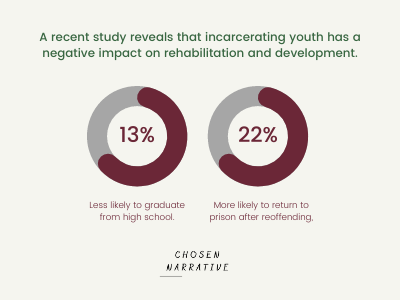
Sadly, the reality is often very different. A new study by economists reveals that existing juvenile incarceration increases the odds of recidivism and reduces the possibility of the individual graduating from high school.
The study compared two groups of kids in Chicago. One group received detention for a criminal act, while others did not (for similar crimes). Ultimately, the incarcerated youths were 13% less likely to graduate from high school and 22% more likely to return to prison.
The Solution to Juvenile Detention
Existing youth prisons are not only failing juvenile offenders but also costing taxpayers a lot of money to conduct a fruitless mission. For example, it costs approximately $142,000 per year to incarcerate one young person each year in Virginia, and the recidivism rate is 75%.
In contrast, Youth Advocate Programs offer services in the home and community settings and only cost $27,000 a year. Many of these programs incorporate restorative justice principles that strive to repair harm to victims and encourage youth to give back to their communities.
Various research studies have shown positive reform from the following efforts.
- Establishing a system of care that is focused on meeting the mental health and related needs of youth, such as community-based services and supports.
- Multi-system integration methods to help children in the child welfare, behavioural health and/or juvenile justice systems
- Introducing family-focused alternatives to court intervention
- Establishing new juvenile defence standards for legal teams
- Imposing structure through state-subsidized extracurricular activities that teach valuable life lessons
- Engaging minority groups to better understand lifestyles and decision-making
- Incorporating more rehabilitation efforts as a consequence of criminal behaviour
- Adopting a personalised approach to individual cases
- Limit children from being housed in the same facility as adult offenders
The numbers don’t lie. Youth prisons don’t work.
Additional sources:
What would you do if you spent 25 years incarcerated for a crime that you didn’t commit?

While many would be angry and vengeful, Patrick Pursley has chosen to always work for love, which he believes to be the highest vibration of the human spirit.
Patrick Pursley was wrongfully convicted of a 1993 murder. Despite no blood, fingerprint, or DNA evidence to tie Patrick to the crime, political pressure and inconsistent testimonies from a ballistic expert found him convicted.
Despite these tragic circumstances, Patrick has focused on reinventing his story and helping others overcome their vulnerable position.
I Am Kid Culture Movement
Not only did Patrick dedicate time and effort to becoming a jailhouse lawyer, but since his release, he has also started the I am Kid Culture movement which is committed to creating solutions to gun violence. Its mission is to reach at-risk youth to encourage them to set goals, pave career paths and have access to guidance through arts and curriculum.
Causes for at-risk youth in the United States
- Growing up in an area with heavy gang activity
- History of violence in the home
- Too little adult supervision
- Unstructured free time
- Lack of positive role models
- Sense of hopelessness due to limited opportunities
- Underlying mental health issues or behavioural disorders
By reducing the gang and gun violence, Patrick Pursley has tapped into the good of human nature to empower youth.
Bad People is hosted by Dr Julia Shaw and Sofie Hagen. Many people put incarcerated individuals into a box, labelling them as “bad people” without much of a second thought.

Yet Dr. Julia Shaw, a psychologist, and Sofie Hagen, comedian, combine their expertise to make these “horrific” tales relatable.
A Unique approach to storytelling
While discussing stories about dark fantasies, false confessions and wildfire arson, the duo also dives into the way that the mind works and the biases that society holds.

In many ways, the podcast induces empathy by humanising people who do bad things, giving us a greater understanding of their triggers and possible motivations.
If you’re looking for a new podcast that is both educational and entertaining, then we highly recommend Bad People. Listen to Bad People here.
At Chosen Narrative, we aspire to share the individual stories behind statistics. But what happens when these statistics are skewed?
A study by the marshall project
It’s not unusual for politicians to use statistics to their advantage, even if the presentation of the numbers needs to be tweaked slightly. The Marshall Project recently published a fascinating article that demonstrates how political leaders amplify certain figures and shift metrics in order to further their campaign.
The article covers Operation Lone Star and describes how Texas Governor Greg Abbott skewed data to suggest that a multi-billion dollar border operation was working. His main goal? To get re-elected.
Gary Hale, a former Chief of Intelligence for the Drug Enforcement Administration said, “The whole reason for all this, you know, playing with statistics, is for optics so that the governor could get re-elected. We really haven’t had any significant impact on migrant smuggling or drug trafficking.”

Is our trust in statistics misplaced?
Where does that leave us as the general public? Is our trust in statistics misplaced?
Alone, statistics only scratch the surface. Listening and learning will take us deeper toward better understanding.
Read the full story on The Marshall Project here.
At Chosen Narrative, we're committed to using language and storytelling to educate, induce empathy and inspire change.

Advocates have argued that choice of language can have stigmatizing effects that can negatively impact a person's ability to participate in social life and prevent them from reaching their full personhood. The World Health Organization recommends that language should not discriminate against stereotype or demean people based on age, ethnicity, gender, sex or sexual orientation and physical or intellectual impairments.
However, it doesn't specifically address the impact that stigmatizing language has on people involved in the criminal justice system. We hope to use language to empower people in the criminal justice system - and beyond.
There are certain words that were regularly used throughout history but have since been removed from everyday vocabulary, and for very good reason. In fact, using some of these discriminatory terms can trigger violent responses, inspire hatred and solidify stereotypes.
Words used in the system
How much thought do you give when referring to an incarcerated individual? Do you consider how the act of branding a person will impact their identity as well as their ability to overcome existing challenges?
Consider the words typically used for people in jail and/or prison:
- Inmate
- Prisoners
- Convicts
- Felon
- Offender
These words are more weighted than they seem.


A little bit of independent thought can challenge social conditioning. A recent series published by The Marshall Project sheds light on the power of language, and why it matters when talking about the criminal justice system - and those involved.
The death of George Floyd kickstarted a new wave of social justice, activism and increased awareness of criminal justice. Since then, various individuals and groups have used the momentum to push for policy change and raise awareness on concerning issues with existing systemic “justice”.
What many don’t realize is that the current movement is another milestone in a very long journey striving toward social justice.
Language of incarceration
Senior lecturer at University of Essex , Alexandra Cox, explores the language of incarceration, saying, “Radical prison activists in the 1960s and 1970s used the official language of the prison state to challenge its power."
She notes that leaders also strived for reform, with President Obama writing an article in the Harvard Law Review about criminal justice reform strategies, invoking language such as “formerly incarcerated individuals”.


Read more about Alexandra’s think piece of using “people first” language in the context of incarceration for context on a historical and contemporary perspective.
