Consider the problem and the context of education for Roma children and youth. Let's explore the process by which a Roma student may be placed in a remedial special school and how this process is flawed?
Despite being the largest ethnic minority in Europe, Roma have been continuously discriminated against for centuries. While discrimination has evolved over the years, education remains a critical concern.

Context of Education
Eurocities report summarizes the context of education for Roma children and youth, revealing that Roma are less likely to attend secondary or higher-level education. Those children who do enroll typically have higher rates of absenteeism and drop-outs (2017).
Problem of Education
Across cities, the education of Roma children is associated with weak learning outcomes, high absenteeism, dropouts, and overrepresentation in special education (EuroCities, 2017). These factors lead to a lower level of education, which further contributes to unemployment and the repetitive cycle of poverty and stigmatization as Roma struggle to find jobs.
While (some) cities have attempted to correct the social exclusion of Roma, it has become apparent that prejudice and discrimination are deeply ingrained within the social and political culture of European cities.
Remedial Schools
The under-representation of Roma in the education system, including teachers from Roma communities, feeds into distrust in the school education system. Distrust combined with Roma cultural factors, such as high mobility, and socio-economic difficulties, places Roma children at a disadvantage in their early development compared to other children (EuroCities, 2017).
Delayed development without proper intervention has led to the over-representation of Romani children in special schools. By disproportionately placing children in special remedial schools, the education system becomes guilty of discrimination.
This form of discrimination has become another emerging problem for the education crisis among Roma children, as emphasized by the landmark case D.H. and Others vs. the Czech Republic, which determined that Roma in the Czech Republic were subject to unlawful discrimination due to disproportionate numbers of Romani children being placed in remedial special schools for children with mild special educational needs (SEN) (Cashman, 2017).
Even attempts at educational reform by the government have fallen flat. For example, implementing “practical schools” for Roma children that offer a standard primary curriculum is void of any modifications to assist the ability of individual students. In another example, the definition of SEN is loose at best. Ingrained prejudice is also apparent in how teachers refer Romani children for psychological testing when they start struggling rather than implement strategies to help them.
Critical Race theory
Cashman uses the Critical Race Theory (CRT) to argue that institutional racism persists in the Czech Republic to shape attitudes and practices at all levels, leading to the misdiagnosis of Romani children. CRT highlights “the social construction of racial identities, critique of color-blind policies, and the interrogation of intersections of race and class in the formation of identity” (Cashman, 2017).
Bruneau takes CRT one step further to suggest dehumanization as the source of ethnic-based discrimination, even among teachers who were lowest in prejudice (2020).
With this in mind, governmental policy attempts to end segregation will continuously fail due to deeply-rooted institutional discrimination that directly (and indirectly) asserts the power and privileges of the majority (white) population.
References
- Bruneau, E., Szekeres, H., Kteily, N., Tropp, L.R., & Kende, A. (2020). Beyond dislike: Blatant dehumanization predicts teacher discrimination. Group Processes & Intergroup Relations 23, 4, 560-577.
- Eurocities. (2017). Mapping_of_the_situation_of_Roma_in_cities in Europe. The European Union Programme for Employment and Social Innovation "EaSI" (2014-2020).
- Cashman, L. (2017). New label no progress- institutional racism and the persistent segregation of Romani students in the Czech Republic. Race, Ethnicity and Education 20, 5, 595-608.
It’s no secret that youth from racial and ethnic minorities experience difficulty in the justice system, and diversion strategies are no different.

Brittanica describes diversion as “any of a variety of programs that implement strategies seeking to avoid the formal processing of an offender by the criminal justice system.”
Essentially, diversion carves a path for rehabilitation and reform outside of prison. When it comes to managing criminal behavior among juveniles, diversion offers juvenile offenders a chance to get an education and make the most of their lives without a criminal record.
Unfortunately, there is a massive disparity between white youth and youth of color being diverted, meaning that youth of color get caught in the criminal justice system.
Benefits of youth diversion strategies
The Sentencing Project describes how diversion should be applied to all youth of all racial groups and can be exercised both pre-arrest and pre-court. In both instances, there are benefits to youth development, showing the following research-proven benefits;
- Less likelihood of future arrests
- Less likely to be incarcerated
- Less violence is committed
- Higher rates of school completion and college enrollment
- Earn higher incomes as adults
Diversion programs may include mental health programs or substance abuse rehabilitation efforts. Proper screening is needed to determine the root cause of delinquency, and then education and tutorial services follow.
Some diversion programs include victim awareness classes, job skills training, crisis intervention, family counseling, and quality recreation and organized sports programs.

Difficulties facing diversion
If youth diversion offers so many benefits, why isn’t diversion applied in more circumstances?
Sentencing Project dives into one of the biggest problems with diversion programs — the subjective bias that haunts the system.
State laws seldom stipulate clear criteria for diversion, leaving the decision in the hands of biased individuals. Unfortunately, the issue affects certain groups of people more than others.
There are three main pillars of bias evident in the diversion system.
- Bias against juveniles of color
- Bias against families of color
- Unequal justice by geography (vast differences in diversion practices between different jurisdictions
Problematic practices heighten these disparities.
For example, unnecessary rules limit eligibility for diversion to youth referred to court for the first time on misdemeanor or status offenses.
Other issues include;
- Poor efforts to inform youth and their families regarding participation
- Requirement that the juvenile admits guilt to qualify
- Rules that serve as a barrier for families to meet program requirements
- Fees or costs involved in the participation of diversion programs
- Lack of support for youth and families at risk of failing diversion
Overcoming the obstacles facing diversion strategies
The first step to overcoming the obstacles that face diversion strategies is to acknowledge they exist. With a clear understanding of the bottlenecks and biases in the system, the challenges can be overcome effectively.
The Sentencing Project further reveals how some states are already incorporating strategies to overcome these issues. For example:
- Funding is provided to support diversion programs
- Intensify efforts to contact family members
- Reduce imbalances in diversion opportunities by setting standard guidelines
- Minimize consequences for non-compliance with diversion rules and requirements
- Create new mechanisms to support youth in need Improve data collection for a more accurate representation of progress
There are a few key fundamentals that local advocates and systems leaders should focus on. The following strategies can help diversion strategies become a positive alternative to incarceration.
- Reducing racial and ethnic disparities to make diversion more accessible
- Reassessing rules that exacerbate disparities Identifying and responding to implicit bias
- Demanding that youth justice systems prepare racial impact statements to understand existing policies and practices better
- Focusing on data to reduce disparities and enhance opportunities
- Appointing an oversight body to track progress
Ultimately, diversion has incredible potential in youth justice reform, and aggressive action is needed to counter racial and ethnic disparities in diversion programs.

Did you know that children (under the age of 18) can receive life sentences in 73 countries, including the United States?
Even more tragic than juveniles being incarcerated without adequate rehabilitation is that most countries fail to keep accurate records of the number of children who are incarcerated for breaking the law, resulting in a lack of accountability.
As a guideline, United Nations Children’s Fund, UNICEF, has estimated that more than one million children are behind bars worldwide. Considering that many of these children (who grow into adults) endure harsh and demeaning conditions and are deprived of education, the possibility of recidivism is high.


We recently shared how exoneree Patrick Pursley has invested time and energy into reaching at-risk youth — but what obstacles does he have to tackle?
Individual Risk Factors
The first major risk is the individual self, including both controllable factors as well as intrinsic.
Consider the following;
- Involvement in general offences and substance abuse before the age of 12
- Experimentation with drugs, alcohol, and/or tobacco
- Males tend to be more likely to be violent and aggressive than females
- Psychological conditions, including behavioural and mental health struggles
- Genetic conditions and birth complications that affect the brain and nervous system
In many instances, these risk factors appear small on their own but are compounded when combined with one another and external factors such as family and community.
Family Risk Factors
Family risk factors introduce the age-old argument of nature vs nurture, playing a role on both sides. On the one hand, natural genetics are passed down from parent to child, and on the other hand, a child's upbringing contributes to their nurtured development.
Studies reveal that parents represent an environmental risk factor rather than a genetic one, suggesting that children learn violent and antisocial behaviour by observing their parents.
Discipline
Discipline (or the lack thereof) remains a pertinent factor to consider when studying the violent tendencies of a child. While children need consistent, reasonable discipline, abusive discipline can shift the boundaries of acceptable treatment toward others.
Broken home
Parental separation and divorce, as well as single-parent homes, continue to present a significant obstacle. The stress and pressure of these changes, as well as the lack of support and supervision, can impact the stability of the home structure and lead to violent behaviour.
Antisocial behaviour
Parents who lack interpersonal skills and personal efficacy can fail to develop their child’s social competence. As a result, children can develop a bitter and resentful attitude. Parents that demonstrate a disregard for right and wrong, persistent lying and disrespectful attitudes can establish an ill-guided understanding of what is normal. In the process, these standards can encourage or make excuses for criminal behaviour.
Community Risk Factors
The peer environment and surrounding community are two of the most discussed risk factors for juvenile delinquency. It’s also the area with the most potential for intervention.
Some examples of community risk factors include;
- Peer group - aggression among friends can be contagious
- Lack of education opportunities
- Socially disorganised communities
- Communities with high crime rates, gang activity and drug use
Research shows that juvenile arrest rates are higher among impoverished youth, and the general trend reveals family violence and gang activity accompany impoverished communities.
Consider the stories told in Warren’s Unorthodox project focused on gang activity and rehabilitation in South Africa as an example of gang culture influence.
Tragically, these risk factors create a dangerous cycle of crime and hopelessness. What starts as the decision to vandalise, commit petty theft or join a gang has severe knock-on effects. It robs juveniles of education and replaces admirable role models with dangerous icons.

Juvenile Detention vs. Adult Detention
Actions have consequences, and sometimes being in the wrong place at the wrong time also has consequences. Prisons, sometimes called correctional facilities for PR purposes, should work to amend criminal behaviour, upskill offenders and address mental health concerns.
So, what happens when a minor is sent to juvenile detention after their behaviour is shaped by individual, family and community risks?
First, it’s important to acknowledge that not all minors are treated as such. According to the Juvenile Law Center, thousands of children are locked up in adult prisons and jails. In some instances, incarcerated youth are exposed to strip searches, solitary confinement and abusive practices, which add to emotional trauma and disrupt healthy development.
In theory, juvenile incarceration fundamentally differs from adult incarceration by placing more emphasis on rehabilitation - as opposed to punishment for adult offenders.
By separating juvenile offenders from adults, the hope is that they will have a second chance at successful social integration. Juvenile facilities usually have very tight schedules, incorporate education and provide access to more programs.
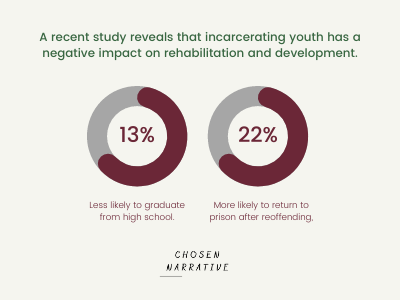
Sadly, the reality is often very different. A new study by economists reveals that existing juvenile incarceration increases the odds of recidivism and reduces the possibility of the individual graduating from high school.
The study compared two groups of kids in Chicago. One group received detention for a criminal act, while others did not (for similar crimes). Ultimately, the incarcerated youths were 13% less likely to graduate from high school and 22% more likely to return to prison.
The Solution to Juvenile Detention
Existing youth prisons are not only failing juvenile offenders but also costing taxpayers a lot of money to conduct a fruitless mission. For example, it costs approximately $142,000 per year to incarcerate one young person each year in Virginia, and the recidivism rate is 75%.
In contrast, Youth Advocate Programs offer services in the home and community settings and only cost $27,000 a year. Many of these programs incorporate restorative justice principles that strive to repair harm to victims and encourage youth to give back to their communities.
Various research studies have shown positive reform from the following efforts.
- Establishing a system of care that is focused on meeting the mental health and related needs of youth, such as community-based services and supports.
- Multi-system integration methods to help children in the child welfare, behavioural health and/or juvenile justice systems
- Introducing family-focused alternatives to court intervention
- Establishing new juvenile defence standards for legal teams
- Imposing structure through state-subsidized extracurricular activities that teach valuable life lessons
- Engaging minority groups to better understand lifestyles and decision-making
- Incorporating more rehabilitation efforts as a consequence of criminal behaviour
- Adopting a personalised approach to individual cases
- Limit children from being housed in the same facility as adult offenders
The numbers don’t lie. Youth prisons don’t work.
Additional sources:
Bad People is hosted by Dr Julia Shaw and Sofie Hagen. Many people put incarcerated individuals into a box, labelling them as “bad people” without much of a second thought.

Yet Dr. Julia Shaw, a psychologist, and Sofie Hagen, comedian, combine their expertise to make these “horrific” tales relatable.
A Unique approach to storytelling
While discussing stories about dark fantasies, false confessions and wildfire arson, the duo also dives into the way that the mind works and the biases that society holds.

In many ways, the podcast induces empathy by humanising people who do bad things, giving us a greater understanding of their triggers and possible motivations.
If you’re looking for a new podcast that is both educational and entertaining, then we highly recommend Bad People. Listen to Bad People here.
At Chosen Narrative, we aspire to share the individual stories behind statistics. But what happens when these statistics are skewed?
A study by the marshall project
It’s not unusual for politicians to use statistics to their advantage, even if the presentation of the numbers needs to be tweaked slightly. The Marshall Project recently published a fascinating article that demonstrates how political leaders amplify certain figures and shift metrics in order to further their campaign.
The article covers Operation Lone Star and describes how Texas Governor Greg Abbott skewed data to suggest that a multi-billion dollar border operation was working. His main goal? To get re-elected.
Gary Hale, a former Chief of Intelligence for the Drug Enforcement Administration said, “The whole reason for all this, you know, playing with statistics, is for optics so that the governor could get re-elected. We really haven’t had any significant impact on migrant smuggling or drug trafficking.”

Is our trust in statistics misplaced?
Where does that leave us as the general public? Is our trust in statistics misplaced?
Alone, statistics only scratch the surface. Listening and learning will take us deeper toward better understanding.
Read the full story on The Marshall Project here.