Did you know that children (under the age of 18) can receive life sentences in 73 countries, including the United States?
Even more tragic than juveniles being incarcerated without adequate rehabilitation is that most countries fail to keep accurate records of the number of children who are incarcerated for breaking the law, resulting in a lack of accountability.
As a guideline, United Nations Children’s Fund, UNICEF, has estimated that more than one million children are behind bars worldwide. Considering that many of these children (who grow into adults) endure harsh and demeaning conditions and are deprived of education, the possibility of recidivism is high.


We recently shared how exoneree Patrick Pursley has invested time and energy into reaching at-risk youth — but what obstacles does he have to tackle?
Individual Risk Factors
The first major risk is the individual self, including both controllable factors as well as intrinsic.
Consider the following;
- Involvement in general offences and substance abuse before the age of 12
- Experimentation with drugs, alcohol, and/or tobacco
- Males tend to be more likely to be violent and aggressive than females
- Psychological conditions, including behavioural and mental health struggles
- Genetic conditions and birth complications that affect the brain and nervous system
In many instances, these risk factors appear small on their own but are compounded when combined with one another and external factors such as family and community.
Family Risk Factors
Family risk factors introduce the age-old argument of nature vs nurture, playing a role on both sides. On the one hand, natural genetics are passed down from parent to child, and on the other hand, a child's upbringing contributes to their nurtured development.
Studies reveal that parents represent an environmental risk factor rather than a genetic one, suggesting that children learn violent and antisocial behaviour by observing their parents.
Discipline
Discipline (or the lack thereof) remains a pertinent factor to consider when studying the violent tendencies of a child. While children need consistent, reasonable discipline, abusive discipline can shift the boundaries of acceptable treatment toward others.
Broken home
Parental separation and divorce, as well as single-parent homes, continue to present a significant obstacle. The stress and pressure of these changes, as well as the lack of support and supervision, can impact the stability of the home structure and lead to violent behaviour.
Antisocial behaviour
Parents who lack interpersonal skills and personal efficacy can fail to develop their child’s social competence. As a result, children can develop a bitter and resentful attitude. Parents that demonstrate a disregard for right and wrong, persistent lying and disrespectful attitudes can establish an ill-guided understanding of what is normal. In the process, these standards can encourage or make excuses for criminal behaviour.
Community Risk Factors
The peer environment and surrounding community are two of the most discussed risk factors for juvenile delinquency. It’s also the area with the most potential for intervention.
Some examples of community risk factors include;
- Peer group - aggression among friends can be contagious
- Lack of education opportunities
- Socially disorganised communities
- Communities with high crime rates, gang activity and drug use
Research shows that juvenile arrest rates are higher among impoverished youth, and the general trend reveals family violence and gang activity accompany impoverished communities.
Consider the stories told in Warren’s Unorthodox project focused on gang activity and rehabilitation in South Africa as an example of gang culture influence.
Tragically, these risk factors create a dangerous cycle of crime and hopelessness. What starts as the decision to vandalise, commit petty theft or join a gang has severe knock-on effects. It robs juveniles of education and replaces admirable role models with dangerous icons.

Juvenile Detention vs. Adult Detention
Actions have consequences, and sometimes being in the wrong place at the wrong time also has consequences. Prisons, sometimes called correctional facilities for PR purposes, should work to amend criminal behaviour, upskill offenders and address mental health concerns.
So, what happens when a minor is sent to juvenile detention after their behaviour is shaped by individual, family and community risks?
First, it’s important to acknowledge that not all minors are treated as such. According to the Juvenile Law Center, thousands of children are locked up in adult prisons and jails. In some instances, incarcerated youth are exposed to strip searches, solitary confinement and abusive practices, which add to emotional trauma and disrupt healthy development.
In theory, juvenile incarceration fundamentally differs from adult incarceration by placing more emphasis on rehabilitation - as opposed to punishment for adult offenders.
By separating juvenile offenders from adults, the hope is that they will have a second chance at successful social integration. Juvenile facilities usually have very tight schedules, incorporate education and provide access to more programs.
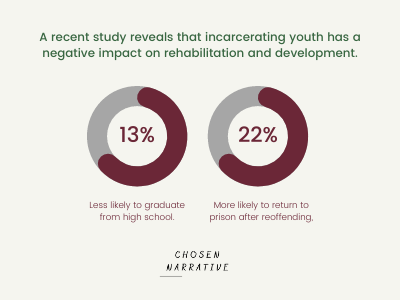
Sadly, the reality is often very different. A new study by economists reveals that existing juvenile incarceration increases the odds of recidivism and reduces the possibility of the individual graduating from high school.
The study compared two groups of kids in Chicago. One group received detention for a criminal act, while others did not (for similar crimes). Ultimately, the incarcerated youths were 13% less likely to graduate from high school and 22% more likely to return to prison.
The Solution to Juvenile Detention
Existing youth prisons are not only failing juvenile offenders but also costing taxpayers a lot of money to conduct a fruitless mission. For example, it costs approximately $142,000 per year to incarcerate one young person each year in Virginia, and the recidivism rate is 75%.
In contrast, Youth Advocate Programs offer services in the home and community settings and only cost $27,000 a year. Many of these programs incorporate restorative justice principles that strive to repair harm to victims and encourage youth to give back to their communities.
Various research studies have shown positive reform from the following efforts.
- Establishing a system of care that is focused on meeting the mental health and related needs of youth, such as community-based services and supports.
- Multi-system integration methods to help children in the child welfare, behavioural health and/or juvenile justice systems
- Introducing family-focused alternatives to court intervention
- Establishing new juvenile defence standards for legal teams
- Imposing structure through state-subsidized extracurricular activities that teach valuable life lessons
- Engaging minority groups to better understand lifestyles and decision-making
- Incorporating more rehabilitation efforts as a consequence of criminal behaviour
- Adopting a personalised approach to individual cases
- Limit children from being housed in the same facility as adult offenders
The numbers don’t lie. Youth prisons don’t work.
Additional sources: